
On keeping
How to preserve family stories, voices, and everyday memories
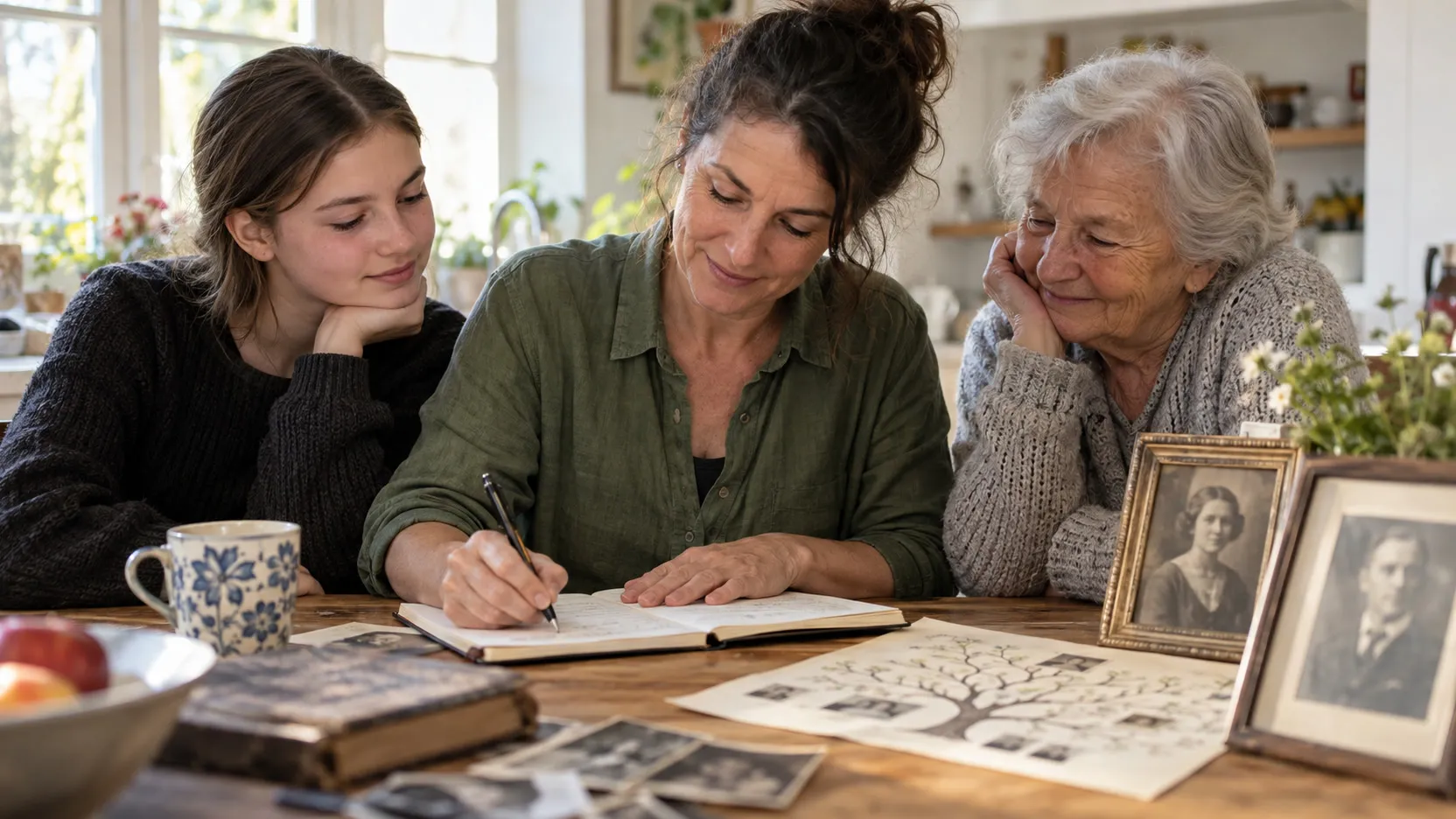
Start with one person, one story, and a recording they agree to make. Save the original, add the names and date, and keep a second copy somewhere separate. You can build a family record with a phone and a folder; you do not need a new subscription to begin.
A family record you can start this week
| What you want to keep | A first step | A guide for the next step |
|---|---|---|
| A parent’s or grandparent’s stories | Ask permission, choose three questions, and record a short conversation. | Ten questions to ask your grandmother |
| A familiar voice | Export a voicemail as an audio file, then play the saved copy. | Save a loved one’s voicemail |
| Mission photos and messages | Download files while you still have account access; check that they open outside that account. | Save mission photos before access changes |
| Your own daily record | Write a few honest lines, in a notebook or a tool you trust. | Begin with one true sentence |
| A story to share with relatives | Ask who may see it, then review the destination’s visibility settings. | Check FamilySearch Memories privacy |
For a printable plan you can fill out without entering names or private stories, choose a starting point in Keep.
Keep the context with the file
A recording called audio-004.m4a is easy to lose track of. A name such as 2026-10-16-grandma-childhood-home.m4a, beside a short note saying who is speaking, who recorded it, and what sharing was agreed, gives the next person a way in. Mark uncertain names or dates as uncertain; don’t turn a guess into a family fact.
Keep the original file. Make a second copy in another place you control, such as a separate drive or a personal storage account. A shared link is a route to a file, not an independent copy. Open both copies and listen to part of the recording before deciding the work is finished. Check them again when you change devices or storage services.
Why I call it the record of the living
Every family I know keeps two archives, and only notices one of them.
The first archive is magnificent. It reaches back centuries: names sourced, dates verified, birthplaces pinned to villages nobody in the family can pronounce anymore. If your people have been at this a while, your great-great-grandmother has a documented christening date and a scanned portrait, and somewhere a cousin is still improving her entry.
The second archive is the one that holds the people who are alive right now — and for most families it is nearly empty. Your mother’s Tuesday-morning voice. The way your father tells the story he always tells, with the pause in the same place. What your grandmother actually prayed for in the hard years. The first archive has custodians, software, and conferences. The second one has a shoebox, maybe, and the assumption that there’s time.
This page is about the second archive. It’s the thesis under everything I write here, so I’ve made it the place the other essays point back to: the record that matters most is the record of the living, and it can only be made while they are.
An old instruction, read forward
For Latter-day Saints, this isn’t a lifestyle suggestion; it’s close to a founding instruction. The first revelation given on the day the Church was organized opens with “Behold, there shall be a record kept among you” — the first line, of the first revelation, on the first day. I’ve written about what the prophets made of that instruction — President Kimball’s forty-four volumes, President Eyring’s nightly question — and about the strange gap we’ve all inherited: a people magnificent at documenting the dead, whose living walk through the kitchen unrecorded.
We usually read the record-keeping counsel backward, toward ancestors. Read it forward instead: you are somebody’s ancestor. The christening date they’ll have. It’s everything else they’ll go looking for.
The three practices
Everything on this site — every essay, every question list, every warning about closing accounts — comes down to three practices. None requires an app. All three can begin tonight.
1. Write your own days down. Not volumes; one true sentence about the day you actually had. The practice is smaller than everyone fears and the yield is larger: kept long enough, a handful of honest lines becomes the thing every descendant wishes existed — proof of what an ordinary week inside your life felt like. If you’ve tried and stalled, it’s almost never a discipline problem; it’s usually a pressure problem, and the fix is a quieter page, not a stronger will.
2. Ask them while you can. The people who hold your family’s stories are not archives; they’re people, mid-story, mostly waiting to be asked. A phone set on the table and ten good questions will do more for your family’s real history in one Sunday afternoon than a year of tree-tending. Ask what and how, chase the sensory details, and don’t fill the silences. The window for this practice is the one that closes without notice.
3. Save the voice itself. Words on a page keep what was said; only a recording keeps how she said it. Most families own forty-seven accidental seconds of someone they’d give anything to hear again. Voicemails, the story everyone’s heard before, the prayer before dinner — thirty unposed seconds of an ordinary evening will someday outweigh every posed photograph you own. And some recordings are on a clock: a missionary’s account closes on its own schedule, and the weekly emails are a record only if someone at home keeps them.
Where the record should live
Not every part of the record belongs in the same place, and most families have never been handed the distinction.
Some of it belongs in the family’s shared spaces — the tree, the photographs every cousin should find. Choose the audience deliberately: FamilySearch Memories offers private and family-group sharing as well as public visibility. Some of what you’ll record was never meant for a display case: the tender entry, the question you’re still carrying, the experience that belongs only to you and God. That part needs a nightstand, not a museum — a place that is private by architecture, not by settings. I’ve mapped the boundary honestly — which records belong with FamilySearch and which don’t — because both places matter and they are not interchangeable.
UNA is the nightstand I built: a quiet, private iPhone app where daily entries stay yours and Sacred Vault content is never sent to UNA’s servers. A personal journal is one familiar way to think about the daily practice; UNA calls those pieces entries and reflections. It exists for this whole practice — but the practice does not wait for it, or for anything.
The standing invitation
Here is the entire discipline, without the essays: tonight, one true sentence about today. This Sunday, one phone on one table and one question you’ve never asked. This month, one voice saved somewhere you control.
That’s the record of the living. Your grandchildren will not ask whether you kept the tree. They’ll ask what you were like — and for once, there will be an answer.
If not now, when?