
On keeping
10 questions to ask your grandmother — and how to record her stories
Part of: How to preserve family stories, voices, and everyday memories
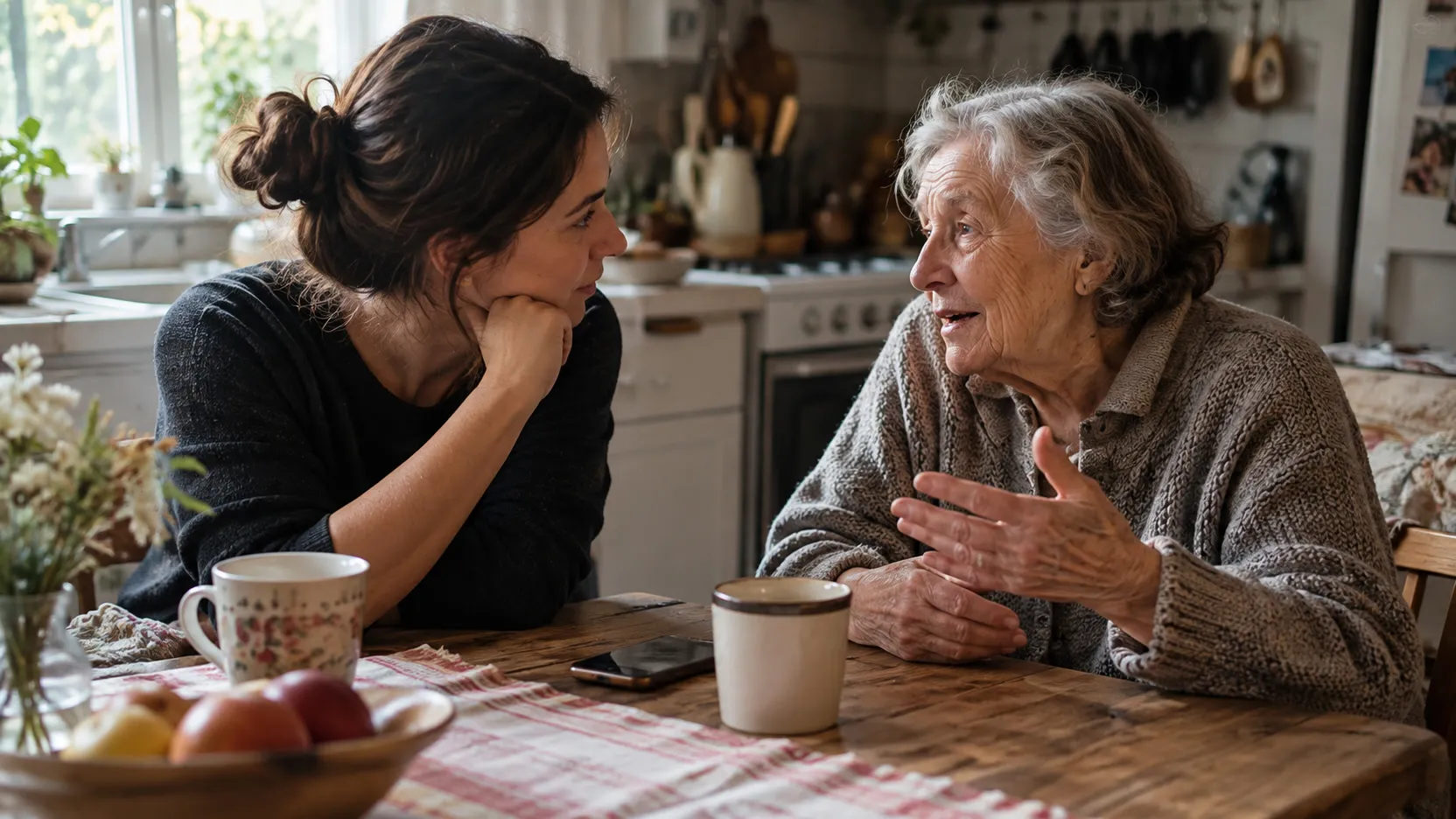
People put off recording their parents and grandparents for one reason more than any other: they don’t know what they’d ask. The moment feels like it needs an occasion, or training, or a plan. It doesn’t. It needs a Sunday afternoon, a phone set on the table between you, and ten good questions.
Start with three questions, ask permission to record, and keep the conversation short enough that she wants another one. These questions can be adapted for a grandfather, parent, or anyone whose stories you want to keep. Change a name or skip a question that doesn’t fit their life.
Before you press record
- Ask whether she is comfortable being recorded and who may hear it afterward. A yes to recording is not automatically a yes to publishing.
- Choose a quiet room and put the phone near both of you. Check that there is room for a recording and enough battery.
- Make a short test in your phone’s recorder and play it back together. If the voices are faint, move the phone closer before starting.
- Pick three questions from the list. Ask one at a time, and let her skip anything she would rather leave alone.
On iPhone, Apple’s Voice Memos guide explains recording controls. Any recorder you already know how to use is a good place to begin.
Here are the ten questions I would start with.
One technique before the questions
When someone gives you a general answer — “oh, it was a good childhood” — don’t move on. Ask one sensory question about the same thing: what did the kitchen smell like, who was sitting where, what were you wearing. Specific memories live behind the general ones, and one sensory detail almost always opens the story underneath. You only need to do this once or twice before it starts happening on its own. If you just keep going, it’s amazing what comes out of people.
Try what and how when a why question feels too pointed. “Why did you leave?” makes a person defend a decision; “How did you decide to leave?” invites them to remember making it. Same question, different door.
The ten questions
1. What’s the first thing you remember about your childhood home? Start here, not with dates and names. Memory opens through the senses, and everyone can walk through their first front door.
2. What did an ordinary Tuesday look like when you were ten? The ordinary days are the ones nobody thinks to tell — and the ones that vanish first. This question rescues them.
3. How did your parents meet — and what did they think of each other at first? You’re not just asking about them. You’re reaching one generation further back than you can reach anywhere else.
4. What did your mother’s kitchen smell like? Ask it exactly like that. Watch what happens.
5. How did you know Grandpa was the one? What almost kept it from happening? The second half is where the story lives. Every courtship has a near-miss, and nobody ever asks about it.
6. When did you first feel that God was real — and where were you standing? “Where were you standing” turns a testimony into a scene. You will remember her answer for the rest of your life.
7. What’s the hardest thing you ever carried — and what carried you? Ask gently, and then don’t fill the silence. The pause is part of the answer.
8. What do you wish you’d asked your grandmother? This one is for both of you. Whatever she says — that’s your next question, one generation too late, and the reason you’re sitting there with a phone on the table.
9. What should the grandchildren know about this family that nobody thinks to tell them? Every family carries instructions that were never written down. This is where they come out.
10. What are you not done with yet? End facing forward. She is not an archive; she’s a person mid-story. This question tells her you know that.
After the conversation: make it findable
Play back a little of the recording while you are still together. Note the date, who was there, and any names that would be hard for another relative to spell. Let her correct an account or ask you to leave something out of a shared copy; keep the intended audience clear.
Export the audio rather than relying on a link to a recording app. On iPhone, Apple’s export instructions explain Share and Save to Files. Name the file with the date, speaker, and subject, and make a second copy somewhere separate. Open that saved copy and check that it plays.
The family-record guide brings the stories, dates, and copies together. If you already have a message you want to keep, the voicemail guide is a smaller place to start. You can also print a recording plan before the visit.
One honest word
Skip half of these if the conversation goes somewhere better — the list is a door, not a script. Twenty minutes is enough. You can do it again next month.
And here’s the honest word: you don’t need UNA to do this. The Voice Memos app on the phone already in your pocket will hold her voice tonight. Do it with whatever you have — the recording matters more than where it lives. UNA exists because I believe these recordings deserve a home worthy of them: kept with the stories that explain them, safe for the grandchildren who’ll ask someday, never lost in a scroll of screenshots. It’s on the App Store now — and when its family rooms open, it will be a better home for her voice. But don’t wait for that. Don’t wait for anything.
If not now, when?